
BSNL eSIM Explained: Availability, Activation Process & Supported Devices (2025)
Quick Summary
What it is
Digital SIM that removes the need for a physical card.
Availability
Phased rollout in select telecom circles; check BSNL website for updates.
Supported Devices
iPhone XR/XS, 11–15 series, SE 2020/2022; Samsung Galaxy S20–S22, Note 20+, Z Fold/Flip; Google Pixel 2+; Huawei, Motorola, Oppo models.
Activation
Convert existing SIM at CSC or get a new eSIM with in-person KYC.
Physical SIM vs eSIM
eSIM offers easier switching and dual-SIM use; physical SIM still useful for older devices and rural areas.
BSNL eSIM has become a widely discussed topic in 2025 as India’s state-run telecom operator gradually modernises its network and services. With private operators already offering eSIM at scale, many users are now searching whether BSNL eSIM is available, how it works, and which smartphones support it. Gadget Hub 360 explains the current status of BSNL eSIM, its activation process, and what users should realistically expect this year.
What Is BSNL eSIM and Why It Matters in 2025
An eSIM (embedded SIM) is a digital SIM that eliminates the need for a physical card. BSNL eSIM allows users to download their mobile profile directly onto compatible smartphones. In 2025, eSIM adoption is rising due to better device support, easier switching, and improved security.
For BSNL, eSIM is also an important step toward aligning with modern telecom standards, especially as the operator prepares its network for future upgrades, including 5G coverage across India.
BSNL eSIM Availability in India
As of 2025, BSNL eSIM in India is available in select telecom circles and customer service centres. The rollout is gradual and not yet nationwide. Availability largely depends on circle-level readiness and backend system upgrades.
Users are advised to confirm eSIM availability at their nearest BSNL Customer Service Centre (CSC) or check the BSNL official website for more information.
Supported Smartphones for BSNL eSIM
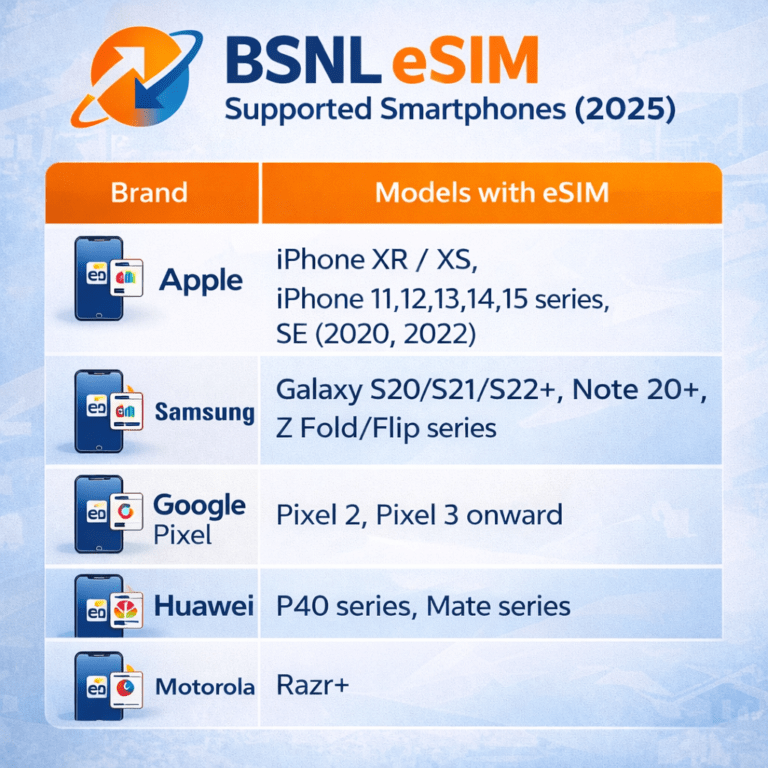
Apple iPhone Models
- iPhone XR, XS
- iPhone 11, 12, 13, 14, 15 series
- iPhone SE (2020 and 2022 models)
Android Phones Supporting BSNL eSIM
- Samsung: Galaxy S20, S21, S22 series (including + models), Note 20+, Z Fold and Z Flip series
- Google Pixel: Pixel 2, Pixel 3, and all newer models
- Huawei: P40 series, Mate series
- Motorola: Razr+
- Oppo: Find X3 Pro
Compatibility may vary by circle and firmware version, so users should verify support with their local BSNL Customer Service Centre before activation. Some features, like dual-SIM management or eSIM switching, may also depend on the smartphone model and software updates.
How to Activate BSNL eSIM
Convert Physical SIM to eSIM
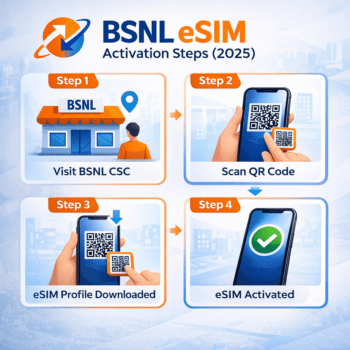
Existing users can request conversion from a physical SIM to BSNL eSIM by visiting a CSC with valid ID proof. A QR code is generated, which must be scanned on the device. Activation usually takes a few minutes, and users should ensure their phone is updated to the latest firmware for smooth setup.
New eSIM Connection
New connections usually require in-person verification. Fully digital onboarding is still under development. Users are advised to carry all KYC documents and confirm circle support before requesting a new eSIM connection.
Physical SIM vs eSIM
In the Physical SIM vs eSIM comparison, eSIM offers easier switching and better durability since there is no physical card involved. It works best on newer smartphones and for users managing multiple numbers.
Physical SIMs, however, remain more practical for feature phones, older devices, and users in rural areas where eSIM-compatible phones are less common.
Gadget Hub 360 Analysis
According to Gadget Hub 360, BSNL eSIM is an important step toward modernising the operator’s services. Its adoption, however, depends on wider availability and a simpler activation process. Until these gaps are addressed, it is likely to remain limited to urban users and premium smartphone owners rather than becoming a mass-market feature.
The Future of BSNL eSIM in India
It is still in its early stages, but the operator is gradually expanding coverage and device support. In the near future, users can expect:
- Wider nationwide availability beyond select circles
- Fully digital onboarding for new connections
- Integration with 5G and other advanced services
- Enhanced support for dual-SIM smartphones